01The poster
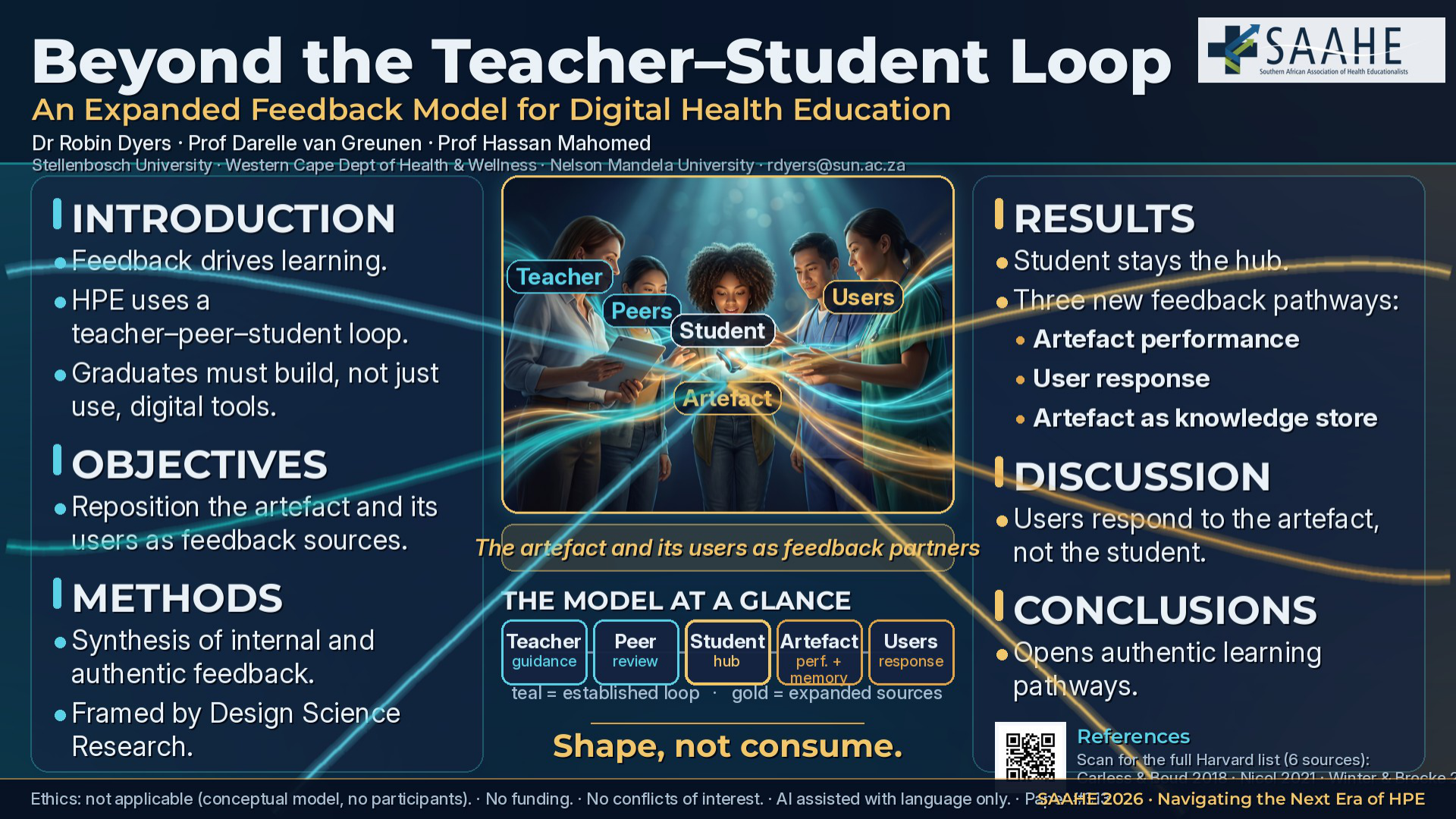
A conceptual model that extends feedback theory beyond the established teacher-peer-student loop, repositioning the design artefact and its users as active feedback sources in digital health education.
SAAHE 2026 · e-Poster #313
Reimagining feedback ecosystems through Design Science Research
Stellenbosch University · Western Cape Department of Health and Wellness · Nelson Mandela University
A conceptual model that extends feedback theory beyond the established teacher-peer-student loop, repositioning the design artefact and its users as active feedback sources in digital health education.
The student remains the comparison hub. To teacher and peer feedback, the model adds three artefact-mediated pathways.
Digital solutions give unfiltered data on design effectiveness.
Real healthcare users contribute authentic, practice-based perspectives.
The artefact accumulates design rationale across iterations, informing later learning.
By triangulating academic guidance with artefact performance and user response, learners widen the comparisons that drive internal feedback and strengthen feedback literacy. Across co-creation cycles, the artefact itself becomes a knowledge repository, carrying design rationale forward into later learning.
The literature review underpinning the poster. Context: Design Science Research in public health.
The purpose of this literature review is to provide an overview of the value of feedback for learning. It explores the link between authentic feedback and effective feedback, internal feedback, and feedback within the context of Design Science Research in public health.
Feedback may be defined as “a process through which learners make sense of information from various sources and use it to enhance their work or learning strategies” (Carless and Boud, 2018). This emphasises the pivotal role of students in actively seeking coherence and understanding of comments to improve their work. The definition extends beyond the typical assumption that feedback comprises teachers conveying strengths, weaknesses and suggestions for improvement to students.
A large-scale Australian survey of teachers and students revealed perceptions that the main purpose of feedback was improvement (Dawson et al., 2019). While students perceived that detailed, bespoke, high-quality comments made for effective feedback, teachers focused on design elements such as task flow, interaction modality and timing.
Although feedback has been recognised as a powerful process for learning (Dawson et al., 2019, 2021), students require capabilities to make optimal use of feedback opportunities. These capabilities are referred to as feedback literacy (Carless and Boud, 2018). The term reflects a considerable shift in the literature: from feedback understood as information provided by teachers, to processes initiated and coordinated by students (Carless and Boud, 2018; Dawson et al., 2021; Nicol, 2021). Students’ abilities to access, understand and use feedback are key determinants of its effectiveness (Dawson et al., 2021). These may be further attributed to five qualities related to authenticity: realism, cognitive challenge, affective challenge, evaluative judgement, and enactment of feedback (Dawson et al., 2021). By optimising these five qualities of authentic feedback, one may optimise the effectiveness of feedback.
David Nicol defined internal feedback as “the new knowledge that students generate when they compare their current knowledge and competence against some reference information” (Nicol, 2021). He claimed that feedback originates internally; that it is underpinned by comparison; and that a student’s initial knowledge and competence of a task, as well as what they compare their performance against, determine the internal feedback generated.
As students compare their own performance with multiple sources of information, they generate internal feedback and iteratively recalibrate their actions to achieve their goals (Nicol, 2021). This internally generated information interacts with external information from multiple sources to self- and co-regulate learning via a conceptual hub of comparison. This hub is conceived as an internal core process, whether the information source is internal or external to the student. Self-regulation may be positively or negatively influenced by the social and physical environment of the student, as well as the student’s internal characteristics, such as knowledge, attitude and beliefs (Nicol, 2021).
In Nicol’s model, external information may come from artefacts such as books, assessment tools, class notes, videos, tools and devices used to solve problems, as well as from interactions with peers, subject-matter experts, teachers, patients, community and friends. Given that students make such comparisons on an ongoing basis, the teacher’s emergent role is to direct students toward realising their own capacity to take full advantage of these natural comparisons.
Design Science Research (DSR) is a research paradigm that seeks to enrich the body of design knowledge through the creation of novel artefacts to solve real-world problems (Winter and Brocke, 2021). An artefact may take the form of a construct (a word or symbol for a concept), model (representation and abstraction), method (processes and practices), instantiation (prototype or implemented innovation, for example e-health software) or design proposition (improved design theory) (Fahrenbach, 2021). Course curricula, presentations, reading lists, checklists and project logs may be regarded as DSR instantiation artefacts within the context of teaching and learning (Winter and Brocke, 2021).
One may be tempted to liken feedback from artefact users to feedback from patients within health professions education. However, within the DSR context, users provide feedback to students about their interaction with an artefact (the science of the artificial / built environment) rather than their interaction with the student (social science and natural science).
The DSR process is inherently reliant on feedback at all stages of artefact development, particularly since there are stages for the student to actively seek feedback on users’ impressions of artefacts, and to communicate the final artefact with its metadata to stakeholders. Design iterations assume that the student is learning from the feedback of teachers, peers and users of the design artefact, and applying those learnings to improvement of the artefact. Nicol’s claim that feedback originates internally to the student through ongoing comparisons (Nicol, 2021) affirms the DSR student’s role as the designer of the artefact, whether developed independently or co-created with target users.
Winter and Brocke assert that students must learn from experience so that they are equipped to plan and scope their own DSR projects to solve real-world problems identified in their individual backgrounds (Winter and Brocke, 2021). DSR teachers provide continuous mentoring and facilitate discussions across varying audiences, whereby students’ artefacts are challenged and developed in terms of the extent to which they solve the targeted problems. This learning may be further enriched by feedback from and to peers.
At the time of publishing their paper, Teaching Design Science Research, in 2021, Winter and Brocke were still exploring ways of incorporating what Carless and Boud (2018) referred to as student feedback literacy: “Currently, we are evaluating options on how to include peer feedback more systematically and to further train students in giving and receiving structured, constructive feedback” (Winter and Brocke, 2021). They encouraged DSR students to present and discuss their ideas and proposals to peers for feedback and, in turn, to provide feedback to others, in fulfilment of their principle of “iterate and progress in richness”.
Within the context of DSR, feedback occurs between students and the teacher, peers and users of the design artefact. While the student interacts with these parties and with the artefact itself, they generate internal feedback by comparing the various sources of information, including internal knowledge, preferences, beliefs and attitude. These sources inform further refinement of the artefact through subsequent co-creation cycles (Fahrenbach, 2021), and may be enhanced by optimising the authenticity of the feedback (Dawson et al., 2021).
The reconceptualised understanding of feedback within academia presents numerous opportunities for enhanced student learning. In addition to unlocking the potential for students to make meaningful academic contributions to the body of knowledge, feedback to DSR students also improves the design of artefacts that solve real-world problems, thereby enhancing the built environment. DSR may be one of the disciplines that needs to be brought along in the shift in understanding feedback, from actions driven by teachers and artefact users toward processes owned by students. The explicit pursuit of feedback literacy as a student competency would benefit both student learning and artefact design.
It may also be beneficial to explore the benefits of authentic feedback, and to capitalise on students’ natural internal comparison as a source of feedback within the context of DSR, bearing in mind that there is an intermediate locus for the high performance of students’ real-world artefacts before their own performance may be gauged.
Full reference list for the poster and background paper.